Re: truth and.. truth
Posted: Fri Mar 20, 2009 8:54 am
fixd teh link
 . And even if immortal, they can get eaten. Then they will be dead, those immortal gobs, init?
It is also pure nature to seek to control your enviroment as much as possible.Machinesworking wrote:To answer the bacteria question dryly, we should always care more for our own species and ones close to ours in structure, on a purely instinctual level. Especially if they served a purpose, IE dogs were/are cheap alarm systems, cats clean the house of mice etc. It's pure nature.
The earth's biosphere has been destroyed multiple times since life came around. And every single time that has happened, there's been an explosion of new and more elaborate forms of life in the aftermath. Check out the Cambrian Explosion on wiki. Catastrophic mass dieoffs, events where 80-90% of all the species currently on the planet go exinct are integral to evolution. It cleans the slate and allows space for new permutations of life to expand.Yeah, nature would stop us from nuclear war or destroying the biosphere. Like the earth goddess will swoop down and smite us or something?
Ethics has nothing to do with evolution, or the biosphere in general. We owe other species nothing, certainly we are not responsible for their continued survival, just as they are not responsible for ours. I totally agree that we should use our intelligence to ensure that conditions on the planet continue to favor human existence, but that's it.
A huge point that you are missing - is that we are talking about ethics and planning a better/more sustainable future for us and the animals that we interact with.
That is simply not true. It may not appear to you that they are at at any one particular point in time, because in a relatively stable environment, natural constraints such as food supply, climate and predators impose restrictions. What happens when seemingly innocious species like rabbits are transplanted to an environment without natural predators and an abundance of food(like Australia) is that their numbers expand like crazy, and they do not stop until they run out of food. They will displace or drive to extinction any native species that cannot compete with them.
Guess what? Many species also do not push themselves to the ecological limits, do your research.
You have no rebuttal so instead you choose to tell them why they shouldn't be in the conversation in the first place and lace it with snide remarks bordering on personal insult?Kodama wrote:So you have no ethics, you owe no consideration to other beings of any species (including your own).
You're a sociopath. Congratulations.
I'm pretty sure if you want to play that role, you have no have no place in a discussion about ethics.
I think it's up to you to explain why you think that. We are more than just the top dog, king of the heap. Not other animal has had as great an impact on life on earth. We are vastly successful, to a degree that we invent ethics and morality to keep ourselves from using our success in violent or counterproductive ways. It's actually maybe the last evolutionary step mankind took, to create a sense of consciousness.Darwinist wrote: What I am trying to say is that appealing to a sense of right or wrong, to ethics or morals in relation to biology or environmental protection is just plain wrong.
I thought that was what I had been doing so far in this thread. You may not agree with my rationale, but it's all there already.Machinesworking wrote: I think it's up to you to explain why you think that.
Not true. That honor most definitely goes to the humble Cyanobacteria familiy of micro-organisms. Before they evolved the ability to synthesize oxygen, there was very little oxygen on planet earth. Many species of micro-organisms had evolved in the oxygen-deprived enviroment, taking advantages of other elements present. They were all forced into extinction by the changing atmosphere. For a long time, far longer than we have been around, Cyanobacteria ruled the planet. Their intake of carbon dioxide, and the process by which they break it down into carbohydrates, expelling oxygen as a waste product, was probably the first environmental "disaster" caused by a lifeform on planet earth.We are more than just the top dog, king of the heap. Not other animal has had as great an impact on life on earth.
Oh please. Look at the planet and tell me that we use our intellect, ethics and morality to refrain from violence. We do nothing of the sort. Homo sapiens hasn't been able to go a single year of it's total existence on earth without war taking place somewhere. We use our intellect to increase our killing capacity, and our morals and ethics to justify whatever specific form of violence we want to enact. And that includes groups like Earth First and Greenpeace.We are vastly successful, to a degree that we invent ethics and morality to keep ourselves from using our success in violent or counterproductive ways. It's actually maybe the last evolutionary step mankind took, to create a sense of consciousness.
How can that be? Conservation is the enemy of evolution. The fact that every major step towards a higher order of complexity in life has been preceeded by an extinction-level event is NOT a coincidence. When stability is reaches, change is impossible. Without change, evolution cannot take place. When the variables don't change, species cruise along on autopilot, the selection pressure diminishes, and the just stay the same. It takes extraordinary events to get things moving again. Creative destruction is a reality, not just in economics but also in evolution. A forest fire destroys individuals, but keeps the forest healthy.I see the tending of nature not as a step away from darwinism, but rather a logical conclusion of our ascension.
"Random sloppy interferences" are the very core of evolution. Your statement seems to imply that our interference will somehow mess up "real" evolution, when nothing could be farther from the truth. Evolution is a directioneless process. It's impossible to get evolution "wrong". What happens, happens. It is a mindless, moral-less process.We are now the major destroyer of anything resembling stability in nature, so given that, why not decide to at least try to step away from nature enough to allow natural selection unhindered to continue without us introducing more random sloppy interference?
You speak of a "place in the order of nature" like there is some guiding intelligence behind this whole thing. There isn't. "Mother nature" doesn't exist. It's just a human abstraction. And being a destroyer is not a trivial task. Destroyers are the engine of evolution. Without destruction, we would still be bacterias.Basically we are at the peak of our evolution, and unlike the cockroach we have no real place in the order of nature other than destroyer.
I wholeheartedly agree with you on doing whatever it takes to ensure the survival of the human race, no doubt about it. Every species is concerned first and foremost with it's own survival. It's when people try to set us up with more "noble" tasks like saving the whales or the pink flamencos that I get a bit annoyed. That is un-natural. We can do it out of vanity, or some self-serving feeling of being "good", but we aren't helping nature one iota when we save endangered species.I see no logical reason to continue to do anything that furthers the elimination of our own species, and deciding that our actions without regard to ethics are always natural is a sure fire recipe for our own extinction.
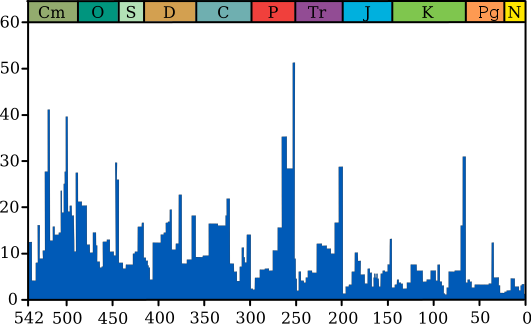
[/quote]1. Present day — the Holocene extinction event. 70% of biologists[citation needed] view the present era as part of a mass extinction event, possibly one of the fastest ever, according to a 1998 survey by the American Museum of Natural History. Some, such as E. O. Wilson of Harvard University, predict that humanity's destruction of the biosphere could cause the extinction of one-half of all species in the next 100 years. Research and conservation efforts, such as the IUCN's annual "Red List" of threatened species, all point to an ongoing period of enhanced extinction, though some offer much lower rates and hence longer time scales before the onset of catastrophic damage. The extinction of many megafauna near the end of the most recent ice age is also sometimes considered part of the Holocene extinction event.[4] Some paleontologists, however, question whether the available data support a comparison with mass extinctions in the past.[5]
2. 65 million years ago (Ma) — at the Cretaceous-Paleogene transition (the K/T or Cretaceous–Tertiary extinction event) about 17% of all families and 50% of all genera went extinct.[6] (75% species). It ended the reign of dinosaurs and opened the way for mammals and birds to become the dominant land vertebrates. In the seas it reduced the percentage of sessile animals to about 33%. The K/T extinction was rather uneven — some groups of organisms became extinct, some suffered heavy losses and some appear to have been only minimally affected.
3. 205 Ma — at the Triassic-Jurassic transition (the Triassic-Jurassic extinction event) about 20% of all marine families (55% genera) as well as most non-dinosaurian archosaurs, most therapsids, and the last of the large amphibians were eliminated. 23% of all families and 48% of all genera went extinct.[6]
4. 251 Ma — at the Permian-Triassic transition, Earth's largest extinction (the P/Tr or Permian-Triassic extinction event) killed 53% of marine families, 84% of marine genera, about 96% of all marine species and an estimated 70% of land species (including plants, insects, and vertebrate animals). 57% of all families and 83% of all genera went extinct.[6] The "Great Dying" had enormous evolutionary significance: on land it ended the dominance of mammal-like reptiles and created the opportunity for archosaurs and then dinosaurs to become the dominant land vertebrates; in the seas the percentage of animals that were sessile dropped from 67% to 50%. The whole late Permian was a difficult time for at least marine life — even before the "Great Dying".
5. 360-375 Ma — Late Devonian extinction. Near the Devonian-Carboniferous transition at the end of the Frasnian Age in the later part(s) of the Devonian Period. A prolonged series of extinctions eliminated about 70% of all species. This extinction event lasted perhaps as long as 20 MY, and there is evidence for a series of extinction pulses within this period. 19% of all families of life and 50% of all genera went extinct.[6]
6. 440-450 Ma — at the Ordovician-Silurian transition two Ordovician-Silurian extinction events occurred, and together are ranked by many scientists as the second largest of the five major extinctions in Earth's history in terms of percentage of genera that went extinct. 27% of all families and 57% of all genera became extinct.[6]
7. 488 Ma — a series of mass extinctions at the Cambrian-Ordovician transition (the Cambrian-Ordovician extinction events) eliminated many brachiopods and conodonts and severely reduced the number of trilobite species.