Well, it is clear from that photo that he "has a wide stance". Perhaps he even knows the proper "foot tapping" code.sweetjesus wrote:im burglarizing turdsnebulae wrote:
"That's right, bitches, I'm fuckin' BT, and I'm checkin' my fuckin' email."
Live PA Article by Mr.Henke Himself

"We could come to the conclusion that only simple, rough, and direct performances are real performances; we could forget about complexity and detail and, next time we are invited to perform, we could grab a drum computer, a cheap keyboard, a microphone, and make sure we are really drunk. It might actually work very well. But what is to be done, if this it is not what we want musically?"
(Emphasis mine)
Robert... have you been reading my diaries? As someone that likes to compose highly melodic, as-far-away-from-minimalist music as possible, this is something I've been considering for a long while. Does a keytar help?
(Emphasis mine)
Robert... have you been reading my diaries? As someone that likes to compose highly melodic, as-far-away-from-minimalist music as possible, this is something I've been considering for a long while. Does a keytar help?

*hugs* bruthachis wrote:Are you a troll in disguise? I don't really have a diary OR a keytar. Although I would like an AX-7...nebulae wrote:Dude, you've got a diary AND a keytar? Please do some push-ups immediately in order to find your manhood.
check out Mutemath...the lead singer is off the hook with his keytar!
smile, and take me MUCH less seriously

that is a great article.
As for the question "what to do"-- the various approaches that people are taking to address this question is part of the continuing evolution. We talk about it all the time on this forum, improving the aspect of expression, etc-- the 'authenticity' of one thing vs another.
Something happened, I think it was in the mid-70's or so, when bands started to refer to themselves more and more as 'artists' but more and more willingly regarded their artifacts more and more ' as product'. There were various movements counter to this that were regarded as being more authentic, and elements of these inevitably get decomposed and sucked back into the 'corporate music' mainstream.
The article refers more to the transcendant experience of getting 'carried away' by music than being entertained... an orchestra is famous for carrying people away, so what is the deal with that?
Well, there is some authority and immediacy that the orchestra conveys that the machine sounding just as amazing as (or more amazing than) an orchestra does not convey. It is an incredibly expensive and inefficient thing, an orchestra: all those brains trained for all those years in many cases to intone notes that have been intoned over and over again. Really, the orchestra 'buys' it's authenticity through brute force. The orchestra needs merely to persuade their friends and relatives to buy tickets and they've filled the hall. Even so, because of the long run of the concept (as opposed to that of the Trautonium) and based on objectivce observance of my own reactions I must conclude that intoning the notes is not the only 'appeal' of an orchestra: it is the live connection of the people to the musical effort, their immersion in the effort.
My $0.02 is that if one is going to exercise a high degree of audio/musical capability electronically, you've got to be similarly immerse in the exercise of the technology: maybe expand yourself by exercising an accompanying degree of visual/artistic capability electronically. An observation is that everyone who is lucky enough to have been able to play 'smart' music to large crowds (King Crimson's Robert Fripp, for example) tends to evolve towards playing 'smarter' music to smaller crowds. Because it's difficult to really envelope a large crowd with the type of [i don't know how you say it-- 'conveyance of complex message/spirit advanced musical/artistic realization experience'?] to the level you'd like to.
As for the question "what to do"-- the various approaches that people are taking to address this question is part of the continuing evolution. We talk about it all the time on this forum, improving the aspect of expression, etc-- the 'authenticity' of one thing vs another.
Something happened, I think it was in the mid-70's or so, when bands started to refer to themselves more and more as 'artists' but more and more willingly regarded their artifacts more and more ' as product'. There were various movements counter to this that were regarded as being more authentic, and elements of these inevitably get decomposed and sucked back into the 'corporate music' mainstream.
The article refers more to the transcendant experience of getting 'carried away' by music than being entertained... an orchestra is famous for carrying people away, so what is the deal with that?
Well, there is some authority and immediacy that the orchestra conveys that the machine sounding just as amazing as (or more amazing than) an orchestra does not convey. It is an incredibly expensive and inefficient thing, an orchestra: all those brains trained for all those years in many cases to intone notes that have been intoned over and over again. Really, the orchestra 'buys' it's authenticity through brute force. The orchestra needs merely to persuade their friends and relatives to buy tickets and they've filled the hall
. Even so, because of the long run of the concept (as opposed to that of the Trautonium) and based on objectivce observance of my own reactions I must conclude that intoning the notes is not the only 'appeal' of an orchestra: it is the live connection of the people to the musical effort, their immersion in the effort.My $0.02 is that if one is going to exercise a high degree of audio/musical capability electronically, you've got to be similarly immerse in the exercise of the technology: maybe expand yourself by exercising an accompanying degree of visual/artistic capability electronically. An observation is that everyone who is lucky enough to have been able to play 'smart' music to large crowds (King Crimson's Robert Fripp, for example) tends to evolve towards playing 'smarter' music to smaller crowds. Because it's difficult to really envelope a large crowd with the type of [i don't know how you say it-- 'conveyance of complex message/spirit advanced musical/artistic realization experience'?] to the level you'd like to.
UTENZIL a tool... of the muse.
-
Pitch Black
- Posts: 6722
- Joined: Sat Dec 21, 2002 2:18 am
- Location: New Zealand
- Contact:
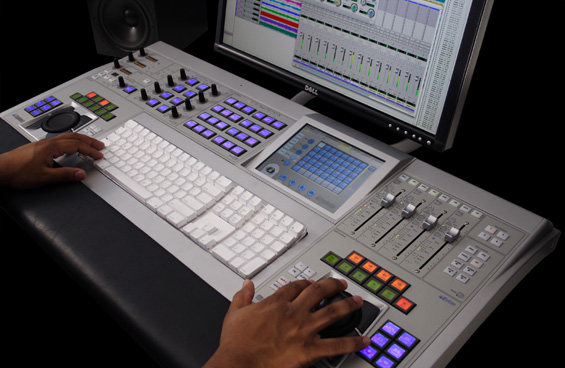
Thats a Euphonix Media Application Controller.pixelbox wrote:Ok, excuse my noob-ness, but wtf is this controller? and will it fit a PC keyboard?
That is awesome!
http://www.euphonix.com/post/products/mc/mc.htm
Just 16000$ in Sweetwater - after a recent 4000$ drop! So cheap...Pitch Black wrote:Thats a Euphonix Media Application Controller.pixelbox wrote:Ok, excuse my noob-ness, but wtf is this controller? and will it fit a PC keyboard?
That is awesome!
http://www.euphonix.com/post/products/mc/mc.htm


it's an interesting analogy.tempus3r wrote:Well. It will take some time.rbro wrote:Cool article. Doesn't really bode well for the future of "complex" electronic music performance though.......
People do not go to movies and get bored because the actors are not acting out for them "live" in real-time.
They accept that the nature of film is too complex to do live. They enjoy it as pre-recorded and edited theater. With that said there is still some value in watching it with other people in a specific public setting.
The same can happen with electronic music.
where analogies can be misleading - it's interesting to follow this one.
Lets say we have a 'live performance' of Time Bandits by Terry Gilliam
He's there on stage in front of the film, with a copy of Avid and a Mac, he looks alternately concerned, happy and thirsty.
that is all we know - we watch the film and it is pretty close to the version we know of it. At one point something seems wildly different and we look to Mr Gilliam expectantly to catch his blaze of free-form editing glory. In fact he is chatting amiably to his girlfriend, not even looking at Avid. We enjoy the experience, but we are a little confused.
In fact, Terry Gilliam does not edit movies, he direct or 'composes' them. It is inappropriate to put Terry Gilliam on a stage to edit a film in real time, the only purpose it serves is to heighten expectation.
Members of the audience not familiar with the film or in film techniques will enjoy the experience much more than the film school students and the projectionists in the audience who will all end up a a big philosophical debate about it.
someone will say "but the few edits he did make were arbitrary and invalid"
someone else will say "well everyone else enjoyed it, you aren't meant to look at him, therefore it is valid"
someones girlfriend will say "who was that guy on stage, he's cute"
That's right. But said people would still be upset if they went to a real theatre and it was just one long projection, no acting, no sets, just one long regular movie they happened to pay 50€ to see.tempus3r wrote:Well. It will take some time.rbro wrote:Cool article. Doesn't really bode well for the future of "complex" electronic music performance though.......
People do not go to movies and get bored because the actors are not acting out for them "live" in real-time.
mbp 2.66, osx 10.6.8, 8GB ram.
well said...to date, my biggest disappointment has been a Blank and Jones show, where they played a pre-recorded set and just stood there PRETENDING to cue CDs, do mixer fades, throw hands in the air. I think Robert's article is much more about changing our conception what "performance" is based on a new definition of what our "instruments" are. Pre-recording everything in a set is about as little a performance as last night's Britney Spears fiasco.Machinate wrote:That's right. But said people would still be upset if they went to a real theatre and it was just one long projection, no acting, no sets, just one long regular movie they happened to pay 50€ to see.tempus3r wrote:Well. It will take some time.rbro wrote:Cool article. Doesn't really bode well for the future of "complex" electronic music performance though.......
People do not go to movies and get bored because the actors are not acting out for them "live" in real-time.
...Yeah, but nobody worships the projectionist like he's some kind of fucking god.tempus3r wrote:Well. It will take some time.rbro wrote:Cool article. Doesn't really bode well for the future of "complex" electronic music performance though.......
People do not go to movies and get bored because the actors are not acting out for them "live" in real-time.
They accept that the nature of film is too complex to do live. They enjoy it as pre-recorded and edited theater. With that said there is still some value in watching it with other people in a specific public setting.
The same can happen with electronic music.